
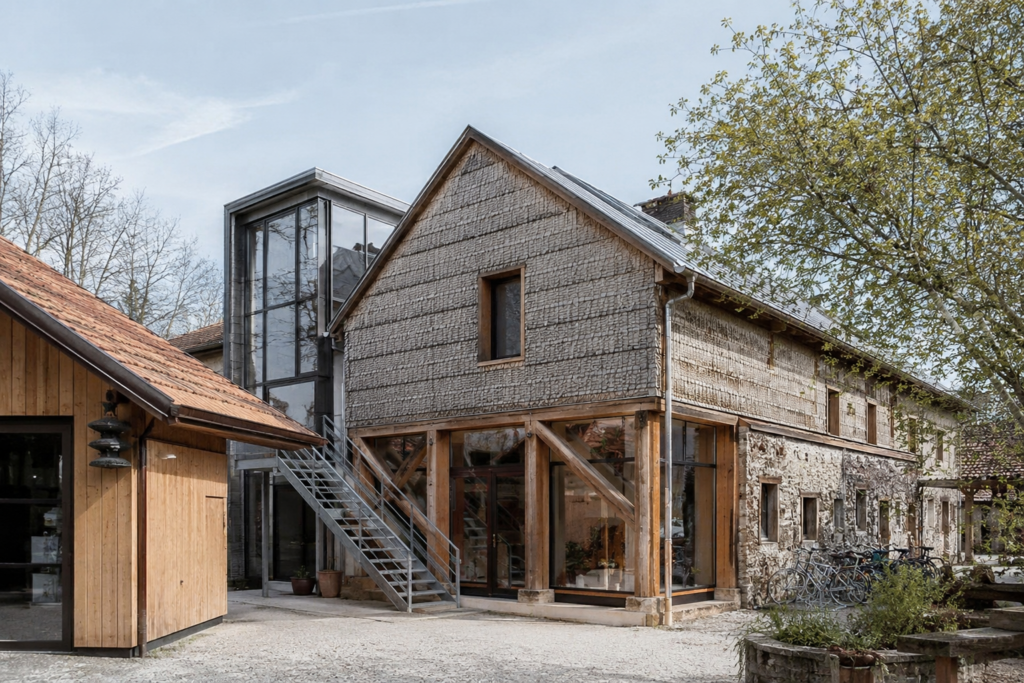
In Belgium, the practice of re-use has been around for longer than in Switzerland. The UC Louvain reports, somewhat tongue-in-cheek, that it is less high-profile than in Switzerland. The channels, tools and framework are indeed well established, even if the practice remains modest. In Switzerland, on the other hand, reuse is evident through exemplary, visible and sometimes highly visible projects.
Perhaps this is the fate of any emerging practice: having to make a name for itself before becoming commonplace. It remains to be seen whether this approach actually speeds up the adoption of re-use or whether, on the contrary, it risks turning it into a distinct architectural language.
We are seeing exemplary Swiss projects that showcase reuse as a new language of architecture. Does this make reuse desirable? Is it a necessary catharsis for the ‘second-hand’ aspect of construction to become an unvarnished part of everyday architecture?
At this stage, reuse undoubtedly needs to be showcased, embraced and put in the spotlight. But does this display, with its disruptive aesthetic, convey its message of simplicity at a time when image is king?
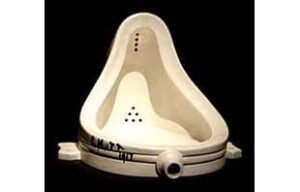
At the beginning of the last century, Duchamp transformed a urinal into a work of art through the power of a gesture and a name: Fountain. An object that has been deconstructed changes its status because it is pointed out, named or displayed. It becomes as much a sign as it is an object.
At the turn of the last millennium, there was the ‘Bilbao effect’: a unique building became an attraction for the whole city and greatly raised its profile. Far from being standard, it is a temple-like building, by definition irreplicable, not only because of its unique form but also because of the extraordinary design process from which it emerged.
A century after Duchamp, certain reuse projects today seem to draw on these two approaches. They present technical achievement or repurposing as their aesthetic rationale. But does this unique emphasis make them desirable? And should reuse remain a symbolic, non-replicable gesture, or should it quietly find its way into everyday practice?
The obstacles to reuse are rarely aesthetic in nature. Yet the way he presents himself and tells his story also plays a part in his popularity.
Swiss architecture is praised for its simplicity and minimalism in terms of aesthetic symbolism, even though these designs often involve concrete structures that are resource-intensive. It is a subtle conflation of building culture and resource conservation: a formal restraint in no way guarantees a saving in materials.
Examples of reused buildings should be able to bear this label of simplicity without being labelled as original, disruptive or even downright ugly – precisely because they do not always conform to the prevailing codes of ‘good’ architecture. This is a far cry from the repetition of elements so dear to Snozzi.
So should we proudly showcase examples of reuse so that this trend, through spectacular examples, permeates the day-to-day practice of architecture? Provided, at any rate, that we focus not on the coverage but on the aim: to preserve and extend the life of the built environment.
The success of reuse will not lie in its continued presence in magazines. Its success will begin on the day it is no longer needed there.